Global Food & Wine: A Connoisseur’s Journey
The realm of Global Food & Wine represents the ultimate intersection of geography, history, and sensory excellence. For centuries, the evolution of culinary traditions has been intrinsically linked to the development of viticulture, creating a rich tapestry of flavors that define civilizations. In the modern era, the accessibility of international travel and the digital exchange of ideas have allowed gourmands to explore these connections more deeply than ever before.
This article delves into the sophisticated world of global gastronomy, examining how various regions have mastered the art of the table and how the synergy of food and wine continues to shape our cultural identity.
The Intersection of Culture and Flavor
At its core, Global Food & Wine is an exploration of terroir—the unique environment where food and grapes are grown. This concept, while often associated with wine, applies equally to the ingredients that form the backbone of international cuisines. From the volcanic soils of Sicily that produce both bright Nerello Mascalese wines and sweet cherry tomatoes to the limestone-rich plains of France, the earth itself dictates the flavor profile of the dining experience.
A professional understanding of this relationship allows for a more profound appreciation of why certain pairings work so harmoniously.
The Historical Evolution of Gastronomy
The history of Global Food & Wine is a story of trade and transformation. The ancient Silk Road not only moved silks and spices but also facilitated the exchange of fermentation techniques and grape varietals. As maritime explorers charted new territories, they brought with them the vines of Europe to the Americas, Africa, and Oceania.
European Traditions: The Old World
France: The Cradle of Modern Enology
France remains the undisputed heart of Global Food & Wine. The country’s Appellation d’Origine Contrôlée (AOC) system has served as a model for the rest of the world, ensuring that products are made according to strict traditional methods.
Italy: A Patchwork of Regional Identity
Italy offers perhaps the most diverse landscape in the world of Global Food & Wine. With over 2,000 indigenous grape varietals and a culinary tradition that varies significantly from one village to the next, Italy is a testament to the power of regionality.
In the north, the heavy, buttery dishes of Piedmont find their match in the high tannins and acidity of Barolo. In the south, the sun-drenched flavors of Sicily and Puglia are reflected in bold, fruit-forward wines like Nero d’Avola and Primitivo.
Spain: Tradition Meets Modernity
Spain has undergone a viticultural and culinary revolution over the last few decades. While traditional regions like Rioja continue to produce world-class Tempranillo aged in American oak, a new generation of winemakers is exploring forgotten varietals and ancient techniques.
The New World: Innovation and Expression
The United States: From Napa to the World
The United States, particularly California, changed the global perception of wine during the 1976 Judgment of Paris, where Californian wines outranked their French counterparts in a blind tasting. Since then, the U.S. has become a powerhouse in the Global Food & Wine scene.
South America: High Altitudes and Bold Flavors
South America has emerged as a critical player in the global market, with Argentina and Chile leading the way. Argentina’s Malbec, grown at high altitudes in the shadow of the Andes, has become a global favorite, known for its deep color and plush tannins. This wine is the perfect partner for Argentina’s world-famous beef, creating a pairing that is both simple and profoundly satisfying.
Chile, with its unique geography protected by the Andes and the Pacific Ocean, produces exceptionally clean and vibrant wines, from structured Cabernet Sauvignon to herbaceous Carménère. The integration of indigenous ingredients with European techniques continues to define the South American culinary identity.
Oceania: Purity and Precision
Australia and New Zealand have brought a sense of purity and precision to Global Food & Wine.
The Art and Science of Pairing
The success of any Global Food & Wine experience relies on a fundamental understanding of pairing principles. At a professional level, this involves balancing the five basic tastes: sweet, sour, salty, bitter, and umami.
Beyond these chemical interactions, there is also the concept of ‘congruent’ versus ‘contrasting’ pairings. Mastering these nuances is what elevates a meal from a simple necessity to a world-class experience.
Sustainable Practices in Global Food & Wine
As we look to the future, the importance of sustainability in Global Food & Wine cannot be ignored. Climate change is fundamentally altering the map of wine production, pushing vineyards into higher altitudes and more northerly latitudes.
In response, many producers are turning to organic, biodynamic, and regenerative farming practices to preserve the health of their land. In the kitchen, chefs are increasingly focused on reducing waste and sourcing ingredients from local, sustainable producers.
Conclusion
The world of Global Food & Wine is a vast and ever-evolving landscape that offers endless opportunities for discovery. By understanding the historical roots, regional characteristics, and scientific principles that govern the relationship between the plate and the glass, we can appreciate the profound cultural significance of the dining experience.
Want to read more Famous Food about click here
Big Shoutout to the guys who made this blog happen UDM
Frequently Asked Questions (FAQ)
What is the best way to start exploring Global Food & Wine?
The best way to start is by focusing on one region at a time. Research the traditional dishes of a specific area, such as Tuscany or the Loire Valley, and pair them with wines produced in that same region. Regional pairings have evolved together over centuries and almost always complement each other perfectly.
How does terroir affect the taste of both food and wine?
Terroir refers to the environmental factors, including soil composition, climate, and topography, that influence the growth of crops and grapes. For example, grapes grown in cool climates tend to have higher acidity and lower sugar, resulting in leaner wines, while those in warm climates produce riper, bolder flavors. Similarly, vegetables grown in mineral-rich soils will have a different nutrient and flavor profile than those grown elsewhere.
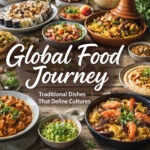
Global Food Journey: Traditional Dishes That Define Cultures